601 Airport Road South Naples, FL 34104
AudiNaples.com
That high-pitched squeal when you press the brakes on your morning commute down US-41 isn’t just annoying—it’s your Audi telling you something important about how Naples’ unique conditions affect your braking system. November through April transforms your daily drive into a completely different experience, with traffic volumes on the Tamiami Trail swelling dramatically and stop-and-go conditions becoming the norm rather than the exception. Your luxury vehicle’s high-performance braking system, designed for precise stopping power, can suddenly start protesting with squeaks and grinding sounds that make every traffic light feel embarrassing. Understanding what’s happening with your brakes—and what you can do about it—makes the difference between enjoying your Audi’s refined performance and dreading every trip through Naples’ busier roads. At Audi Naples Service Center, we help countless drivers resolve this exact issue, especially during peak season when braking demands increase substantially.
If you’re a year-round Naples resident, you’ve definitely noticed the transformation that happens every November. The roads that felt manageable in September suddenly become noticeably more congested as seasonal residents return to Collier County for the winter. This population increase isn’t just a statistic—it fundamentally changes how you drive your Audi every single day. US-41 and the Tamiami Trail, already busy routes connecting Naples to Bonita Springs and Marco Island, see traffic volumes that can make your typical drive stretch significantly during peak morning and afternoon hours.
Here’s what this means for your brakes: instead of smooth, consistent driving, you’re now constantly accelerating and decelerating through much heavier traffic. Every intersection along Airport-Pulling Road, Pine Ridge Road, and Immokalee Road becomes another opportunity for your brake pads to engage with your rotors. While a few stops barely challenge your Audi’s braking system, dozens of stops during every commute generate considerably more heat, friction, and wear. The high-performance semi-metallic brake pads that often come standard on your A-Series or Q-Series Audi were engineered for spirited driving and emergency stopping, but they weren’t necessarily optimized for the endless stop-and-go crawl that defines snowbird season. This mismatch often reveals itself through that telltale squeal you’ve been hearing lately.
You back out of your driveway on a perfectly beautiful Naples morning, press the brake pedal, and hear that embarrassing screech that makes your neighbors glance over. By the time you’ve driven a few blocks, the noise mysteriously disappears. If this scenario sounds familiar, you’re experiencing what technicians call “morning sickness”—a condition particularly common in coastal Florida where humidity levels regularly climb above 70%.
What’s actually happening is straightforward. Overnight, moisture from the humid air settles on your brake rotors. Because rotors need an uncoated friction surface to work properly, they’re naturally vulnerable to surface oxidation. This creates a microscopically thin layer of rust that forms between sunset and sunrise. When you first apply your brakes after your car has been sitting, the pads scrape against this rust layer before clearing it away. That scraping generates the high-pitched squeal you’re hearing—not because anything is broken, but because of the chemical reaction between humid coastal air and exposed metal surfaces.
The reason this happens more noticeably with high-performance semi-metallic pads is their composition. These pads contain metallic particles that provide exceptional bite and heat resistance, making them perfect for aggressive driving. However, those same metallic compounds are harder than softer pad materials, so they produce more noise when they initially contact a rust-filmed rotor surface. Once the rust layer is cleaned off, the noise typically vanishes. While this daily cycle is technically normal, it’s certainly not the quiet, refined experience you expect from your luxury vehicle.
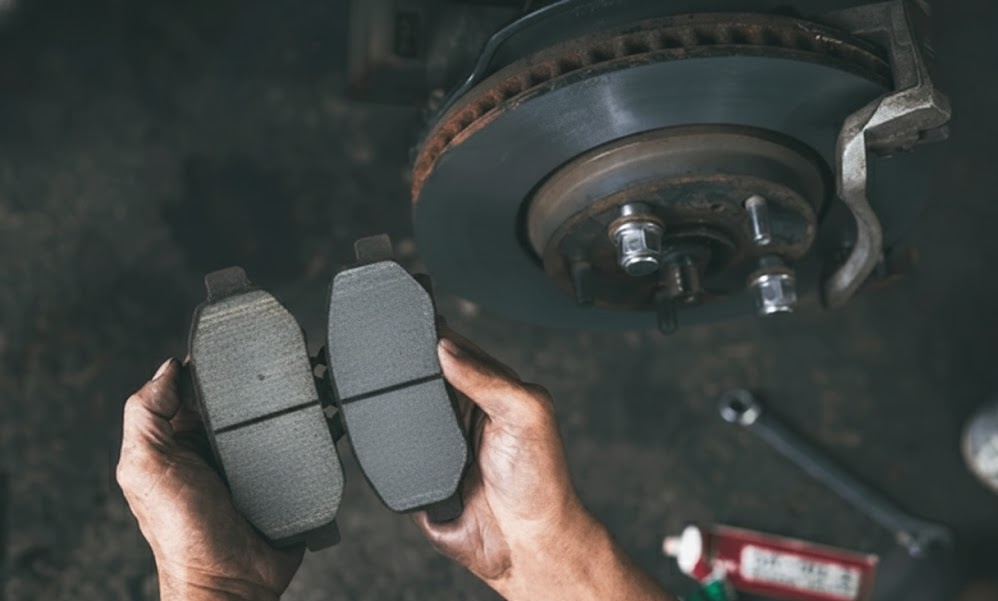
More and more Audi owners throughout Naples, Bonita Springs, and Marco Island are discovering that ceramic brake pads solve multiple problems simultaneously, particularly for peak season driving. Unlike semi-metallic pads, ceramic pads use a compound that includes ceramic fibers, bonding agents, and minimal metallic content. This composition delivers practical advantages that matter for daily driving in Southwest Florida.
First, ceramic pads run much quieter. The softer compound material doesn’t generate the same high-frequency vibrations when contacting rotors, meaning those embarrassing morning squeals largely disappear even when overnight humidity creates surface rust. You’ll immediately appreciate this difference during your commute, as your brake pedal engages smoothly and silently whether you’re stopping at your first traffic light or in afternoon gridlock on US-41.
Second, ceramic pads produce substantially less brake dust. If you’ve noticed that dark, grimy coating accumulating on your Audi’s wheels, that’s brake dust from semi-metallic pads. Ceramic pads, on the other hand, produce a finer, lighter-colored dust that’s less visible and far less likely to bake onto your premium alloy wheels in Florida’s intense heat. For luxury vehicle owners who take pride in their Audi’s appearance, this difference is immediately satisfying.
Third, ceramic pads excel in the moderate-temperature, frequent-braking conditions of Naples traffic. While semi-metallic pads shine during high-performance driving where you’re generating extreme heat, ceramic pads are optimized for consistent, repeated stops at moderate speeds—exactly the kind of braking you’re doing down the Tamiami Trail. They maintain steady friction levels, meaning your pedal feel remains consistent. Making the switch means matching your brake system to your actual driving conditions rather than hypothetical track scenarios.
It’s tempting to dismiss morning brake squeal as merely annoying. However, consistently ignoring unusual noises can lead to expensive problems. Understanding what’s happening inside your braking system helps explain why addressing them sooner rather than later protects both your safety and your wallet.
When brake pads wear down, manufacturers build in wear indicators—metal tabs that contact the rotor and create a warning sound. This is distinct from humidity squealing: it’s a constant scraping noise. If you keep driving, these tabs wear through, and the pad’s backing plate starts contacting your rotors. At this point, you’re actively damaging your rotors, which are significantly more expensive to replace than pads alone. What might have been a straightforward pad replacement can quickly become a complete brake job.
Beyond mechanical concerns, compromised braking performance creates genuine safety risks in congested traffic. When traffic on US-41 suddenly slows, you need your brakes to respond immediately. Worn brake pads don’t grab with the same confidence, lengthening stopping distances without you consciously noticing. This degradation happens gradually, often going unnoticed until a close call forces the issue.
Excessively worn pads can also damage brake calipers and cause uneven wear that stresses suspension components. Even tire wear and alignment can be affected when your braking isn’t balanced. Addressing brake concerns when they first announce themselves keeps these problems isolated and manageable rather than letting them spread into complex repairs.
Your Audi’s braking system represents impressive engineering, with each component designed to work harmoniously. Understanding these components helps you appreciate why professional service using genuine parts matters for your vehicle’s performance.
When these components wear, your Audi’s sophisticated systems notice. Warning lights may illuminate, or you might notice changes in pedal feel. Factory-trained technicians use specialized equipment to identify exactly which components need attention.
| Feature | Semi-Metallic Pads | Ceramic Pads |
|---|---|---|
| Best For | High-performance driving, track use, towing | Daily commuting, stop-and-go traffic, quiet operation |
| Noise Level | Higher, especially with humidity-induced rust | Significantly quieter in all conditions |
| Brake Dust Production | Heavy, dark-colored dust that sticks to wheels | Minimal, lighter-colored dust that’s less visible |
| Performance in Naples Traffic | Excellent when hot, noisy when cold | Consistent across temperature ranges |
| Rotor Wear | More aggressive, faster rotor wear | Gentler on rotors, extended rotor life |
| Humidity Response | Prone to morning squealing from surface rust | Minimal noise even with overnight moisture |
Note: Performance characteristics can vary based on specific pad formulations. Consult with our service advisors to determine the optimal pad type for your Audi model.
Maintaining your Audi’s braking system doesn’t have to mean unexpected surprises. The Audi Care prepaid maintenance program provides a straightforward way to keep your vehicle in exceptional condition. This package covers scheduled maintenance at recommended intervals—typically every 10,000 miles or 12 months—ensuring your vehicle receives consistent attention from factory-trained technicians.
During these visits, we thoroughly inspect your brake system as part of the multi-point inspection. We measure pad thickness, check fluid condition, examine rotors, and verify caliper operation. This proactive approach catches developing issues before they become serious problems, helping you plan for inevitable wear. Rather than discovering you need complete brake service because you ignored warning signs, regular inspections let you plan for normal wear items on your schedule.
The program’s transferability also protects your vehicle’s resale value. Being able to show prospective buyers that your vehicle received consistent, documented maintenance from an authorized service center commands a higher price. Buyers recognize that a well-maintained Audi with complete service records represents a safer, more reliable investment.
Q: Why do my new Audi brakes squeak in the morning?
A: Morning brake squeaking is common in Naples’ humid climate and doesn’t indicate a problem. Overnight moisture creates a thin layer of surface rust on rotors. When you first apply brakes, pads scrape against this rust, creating sound. High-performance semi-metallic pads are particularly prone to this. The squeak typically disappears after a few stops. If you find the noise annoying, switching to ceramic brake pads eliminates most of this morning squealing.
Q: Are ceramic brake pads better for Naples driving?
A: Yes, ceramic brake pads offer distinct advantages for local conditions. They run significantly quieter than semi-metallic pads and produce far less brake dust, keeping your wheels cleaner. Most importantly, they are optimized for the moderate-temperature, frequent-braking conditions of stop-and-go traffic along US-41. Unless you track your car or tow heavy loads, ceramic brake pads are typically the better choice for luxury daily driving.
Q: How long do Audi brake pads last in city traffic?
A: In Naples’ heavy traffic, brake pads typically need replacement between 25,000 and 40,000 miles. Stop-and-go traffic accelerates pad wear compared to highway driving because you engage your brakes more often. The best way to know your pads’ condition is through regular inspections by factory-trained technicians who can measure remaining thickness and predict when replacement will be necessary.
Q: Is brake squeaking covered under my Audi warranty?
A: Brake noise from normal wear or environmental factors like humidity isn’t typically covered, as pads are wear items. However, if you have a very new Audi and experience persistent, unusual noise that suggests a defect, we can evaluate whether warranty coverage applies. A thorough inspection is the only way to know for certain what’s causing your noise and what your options are.
Don’t let annoying brake squeaks diminish the refined driving experience your Audi was designed to deliver. Whether you’re dealing with morning humidity-related noise or peak season wear, the factory-trained specialists at Audi Naples Service Center have the knowledge and genuine Audi parts to restore your vehicle’s quiet, confident performance. We understand the specific challenges Naples drivers face and are equipped to address them properly.
Our comprehensive brake service includes thorough inspection of all components and honest recommendations based on your actual needs. If ceramic pads would improve your daily driving experience, we’ll explain why. With modern amenities including courtesy loaners, getting your Audi expert attention won’t disrupt your schedule.
Or visit us at 601 Airport Road South Naples, FL 34104 to keep your luxury vehicle performing exactly as it should throughout Naples’ demanding driving conditions.